

by Joyce McClure

Communist. Socialist. Progressive. Fascist. Radical left. Far right.
I grew up in the 1950s, when some of those words meant something.
World War II had ended only a few years earlier. Hitler and fascism were recent history. Stalin ruled the Soviet Union until 1953. The Cold War was underway, and Sen. Joseph McCarthy was warning Americans that communists had infiltrated our government.
Those fears reached right into my elementary-school classroom.
We practiced “duck and cover” drills, crawling under wooden desks as though they might somehow protect us from a nuclear bomb. We even wore civil defense dog tags issued to U.S. students during the Red Scare.
For people of my generation, communist wasn’t an abstract political theory. It meant Stalin. Russia. Nuclear weapons. An enemy that might destroy us.
Maybe that’s why I pay attention when President Trump calls Democrats “communists.”
But lately we seem to toss political labels around without stopping to ask whether they actually fit.
Meanwhile, fascist, dictator, and far-right extremist come from the other direction. Even progressive is sometimes said with such contempt that you’d think it was a dirty word.
Which got me wondering: Do we still know what these words mean—or just what they’re supposed to make us feel?
So What Do They Mean?
No little chart can explain a political philosophy completely. But it’s a place to start.
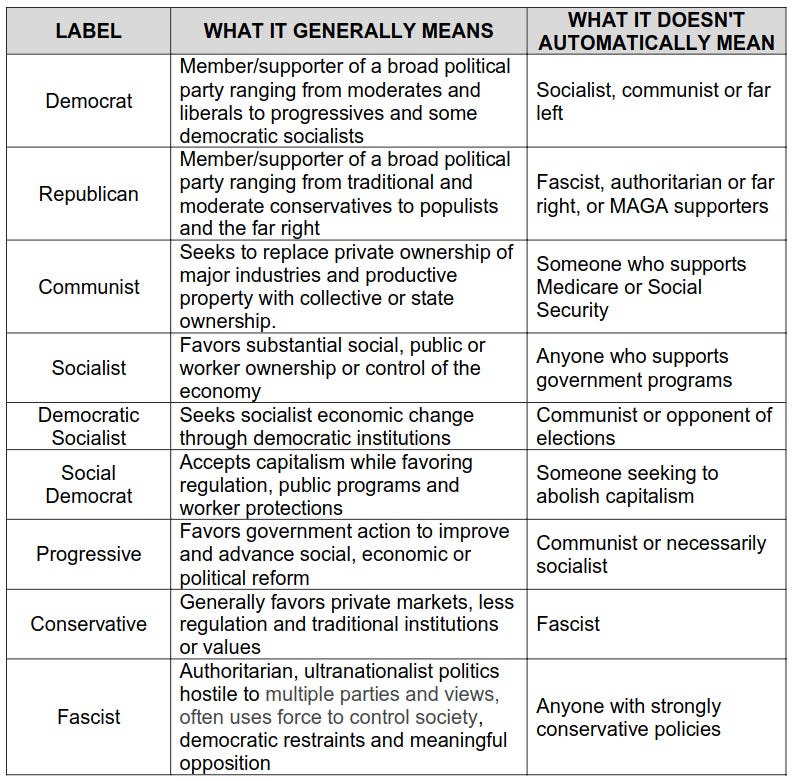
There’s another distinction worth remembering: Democrat and Republican are parties, not ideologies. Both contain people with substantially different political beliefs.
These words aren’t interchangeable. But listen to our politics and you’d never know it.
Are Democrats Communists?
Trump certainly wants us to think so. And there is a kernel of truth behind the attack. There really is a growing socialist movement on the Democratic Party’s left.
The Democratic Socialists of America had fewer than 7,000 members in 2015. Today it has about 120,000. DSA-backed candidates have won several Democratic congressional primaries this year. New York City Mayor Zohran Mamdani proudly calls himself a democratic socialist. And according to a recent New York Times Magazine article on August 13, 2026, DSA includes factions ranging from “slightly left of progressive to outright communist.”
But here’s another number: DSA’s 120,000 members amount to less than 0.3 percent of registered Democrats.
The Democratic Party isn’t proposing to abolish private property, eliminate private businesses, replace markets with a centrally planned economy or establish a one-party state.
Trump has taken something real—a small socialist movement on the Democratic Party’s left—and stretched it beyond recognition.
For people my age, he probably doesn’t even need to define “communist.” We remember what we’re supposed to fear.
Mamdani Really Is a Democratic Socialist
Mamdani is useful because he doesn’t run from the label.
Take his plan for city-owned grocery stores. That’s more than regulating private business. New York City is entering the grocery marketplace with a publicly supported alternative.
There’s clearly a socialist idea in there: public ownership where Mamdani believes the private market isn’t adequately serving people. But Whole Foods isn’t being confiscated. Neither is the corner bodega.
The real issue that should be examined is whether municipal grocery stores will lower food costs or unfairly compete with private businesses.
I’d rather have that argument than one about whether Mamdani is secretly another Stalin.
Then My Head Starts to Hurt
While Trump warns his supporters that Democrats are communists, his own administration has been buying ownership stakes in private companies and expanding the government’s role in strategic industries.
Does that make Trump a communist? Of course not.
That’s the point.
Government involvement in the economy isn’t what communism means. Trump’s approach is better described in some cases as state capitalism: private businesses remain, but the government becomes an investor or uses its power to steer economic activity.
Maybe the old left-right economic line doesn’t tell us everything we need to know about Trump. There’s another line worth watching:
Democratic restraint ←→ Authoritarian power
What About “Fascist”?
Trump’s critics use that word. So let’s check the boxes.
Fascism isn’t simply a nasty word for a conservative Republican. Historically, it has been associated with ultranationalism, strongman leadership, hostility toward political opposition and independent institutions, and concentration of power in a dominant leader.
Does Trump check any of those boxes?
Strongman leadership
Extreme nationalism
Political opponents portrayed as enemies
Attacks on institutions that constrain presidential power
Attacks on judges and the free press
Rejection of an election result when he lost
Admiration for authoritarian leaders
Those are things we can compare with Trump’s record.
Then there’s an almost unbelievable story from Maggie Haberman and Jonathan Swan’s new book, Regime Change. Trump proudly showed them a document arguing that he was history’s most powerful human and comparing his global reach with figures including Hitler, Stalin and Napoleon. He said the assessment came from a “presidential historian” through golfer Gary Player.
It didn’t. The author was Gary Player’s golf caddie.
None of that alone settles whether “fascist” is the right word for Trump. But compare the Democratic Party with the definition of communism, and the basic boxes don’t get checked.
Compare Trump’s conduct with characteristics historically associated with fascism and authoritarianism, and some of those boxes do.
That’s not a reason to throw around “fascist” casually. It’s a reason to know what the word means.
Before You Check the Box, Check the Boxes
When you hear COMMUNIST, ask: What does this person actually propose putting under collective ownership?
SOCIALIST? What would cease to be privately owned or controlled?
PROGRESSIVE? Which policies?
FAR LEFT or FAR RIGHT? Compared with whom?
FASCIST? Which characteristics actually fit?
RADICAL? What’s the radical proposal?
And maybe most important: Who’s using the word—and what do they want me to feel before I stop to think about it?
On November 3, Virginians will check boxes beside the names of the people we want to represent us. We’ll also decide three proposed amendments to our state constitution.
On election day, we should consider where candidates align. Before we check those boxes to vote, maybe we should check a few others.
Does the label fit?
Do the facts support it?
What does the candidate actually believe?
What has the candidate actually done?
What will that candidate do with power?
Will that person respect elections, constitutional limits, independent courts, a free press, legitimate political opposition, and the rule of law—even when they get in the way?
I remember crawling under that wooden desk. I remember the dog tag around my neck. So yes, when a president says “communist,” the word still gets my attention. But getting my attention isn’t the same thing as telling me the truth.
Before you check the box on November 3, check the boxes behind the label. Then make your choice.